
The basic arrangement of the turbidimeter is here. The important photonics parts have been selected to begin with. Electronics and possible software will follow later. So far we have not decided if this will be a stand-alone (with own display) or a pc-controlled (no display) device.
The optical arrangement of our turbidimeter is so called “modulated four-beam” structure which uses two light sources (LEDs) and two detectors, see ref [1] page 7144. The detectors are same but the two LEDs emit different wavelengths, one UV and the other NIR.
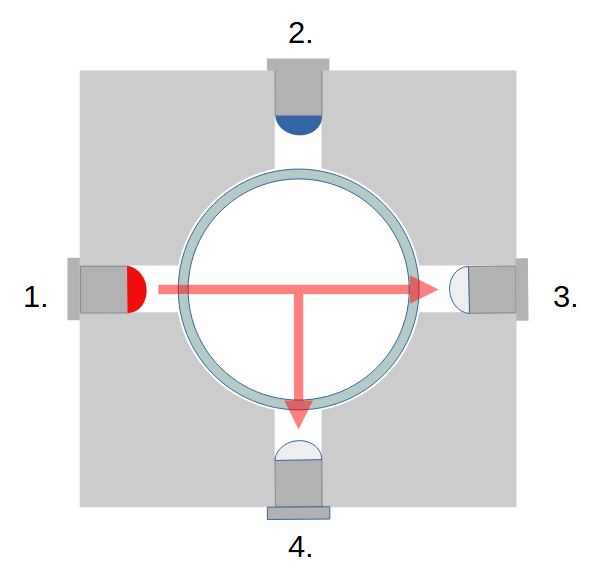
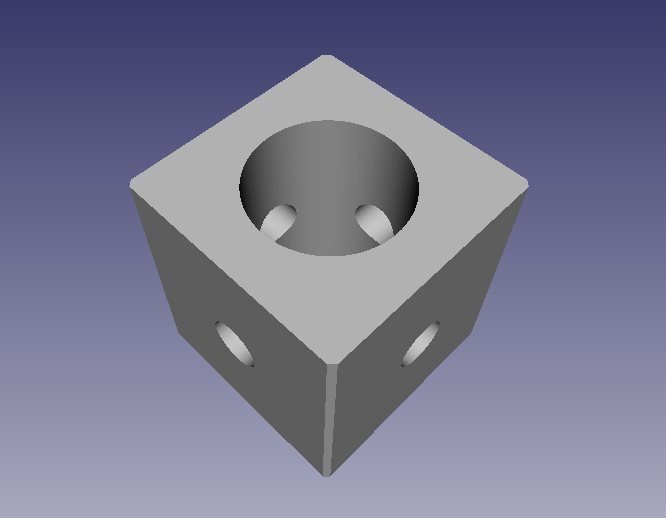
The mechanical part holding the LEDs, the detectors and the sample container will be 3D-printed.
One benefit of this arrangement is that the attenuation of the transmitted beam (0 degree deviation) can be measured and used to normalize the nephelometric readings of the scattered part of the light beam (90 degree deviation). This is important since the intensity of scattered light and therefore the nephelometric values can vary in very nonlinear way. If the turbidity of the sample liquid keeps on increasing, at some point nephelometric valueas may actually start to decline. In notably turbid liquid the light beam attenuates rapidly after a short travel and less light can reach either detector. But by measuring the attenuation of the direct transmission (0 deg), we can compensate corresponding decrease in the nephelometric values detected in 90 deg direction. Without this normalization we had to limit the measuring range significantly and the instrument would be accurate only with slightly turbid liquids.
The other benefit of the modulated four-beam arrangement is being able to make a distinction between different types of scattering particles and of their origin, see ref [2] page 5. Using two different wavelength regions, UV and NIR, gives possibility to estimate the source of the turbidity. Is it organic (algae and phytoplanktons) or inorganic (sand and silt)? It is said on page 5 of the Ref [2] : “Compared to inorganic matter, organic compounds have higher ultraviolet/infrared absorption ratio.”
Selected parts:
- LED 1 , cw @ 860 nm, metal can with lens.
- LED 2 , cw @ 374 nm, metal can with lens.
- Detectors 3 & 4 , Hamamatsu S2386-18L, metal can with lens. Sensitivity in UV is 0.13 A/W and in NIR 0.60 A/W.
References
[1] Sensors 2014, 14, “An affordable Open-Source Turbidimeter”
[2] Sensors 2019, 19, 4439 “Development of a Cost-Effective Optical…”

 Experimental Photonics