
This June I took the spectrometer for a weekend trip to my summer cottage and did some outdoor testing.
I did most of the testing during late evenings when there was no direct sun light but sky was still relatively bright, enough to read a book. So much fun working on damp patio under the darkening evening sky with my old laptop causing new issues (alarmingly warm USB cable and tty/USB0 address of the COM-port jumping randomly on and off).
I was measuring indirect Sun light by pointing the device straight up to zenith where a light gray cloud layer covered the sky. The recorded spectra had several peculiar features that repeated in all of them. The overall distribution was not close to the theoretical form of a black body radiating at Sun’s effective temperature 5780 K. I didn’t use any intensity calibration. The old calibration had became unusable due to a small change in the ADC circuit.
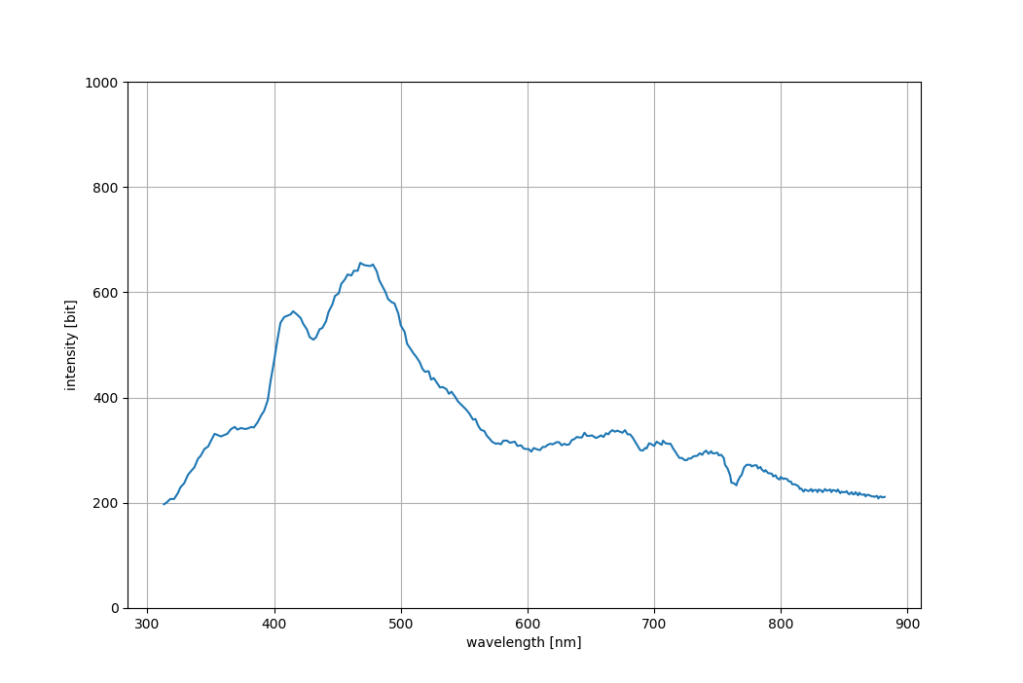
Let’s try to analyze the spectrum I measured that night.
Attenuation effect of the atmosphere can be split into Rayleigh scattering and absorption. (I’m simplifying things but we need to get started.) The effect of Rayleigh scattering can be noticed on relative intensities of wide wavelength bands. Blue wavelengths dominate in indirect illumination. Absorption causes sharp valleys or lines and their wave lengths match those of atmospheric constituents(O2, H2O, O3 etc) and also characteristics of “pure” unaffected Sun light which has many absorption lines too. Common name for all of these absorption features is Fraunhofer lines.
Following data is from Wikipedia Fraunhofer lines article (https://en.wikipedia.org/wiki/Fraunhofer_lines). And please note that my channel width is approximately 3 nm.
Designated absorption so far:
| very weak line @ 358 nm –> Fe | ||
| strong line @ 431 nm –> Ca & Fe | ||
| very weak line @ 579 nm –> ?? | ||
| very weak line @ 603 nm –> ?? | ||
| very weak line @ 627 nm –> O2 | ||
| very weak line @ 654 nm –> ?? | ||
| weak line @ 691 nm –> ?? | ||
| weak line @ 724…726 nm –> ?? | ||
| strong line @ 761…765 nm –> O2 ? | ||
| very weak line @ 818 nm –> O2 ? |

 Experimental Photonics