
The intensity response of the spectrometer depends heavily on a wavelength in question. If we are using this device just to measure locations of spectrum peaks it does not matter much. But if we are interested in wider spectral bands or continuums and their detailed shape we need to consider the intensity calibration (term intensity might be inaccurate here but it is descriptive and refers to amount of light arriving the surface of a detector).
The idea of the intensity calibration is to first measure a source for a well known spectrum and then to find a conversion which transforms the spectrometer raw output into this known spectrum. This conversion is the calibration.
So we need some reference source whose spectrum we know in advance. Easy solution is to use a halogen light bulb. Its output spectrum should be similar to emission of a black body source at that same temperature. I found a clearly written article explaining the principle [1].
I used 12 volt 20 watt halogen bulb (Osram Starlite) operating at 2800K color temperature. The term “color temperature” means that the spectrum of the halogen is equivalent to the spectrum of a black body at that temperature. But it doesn’t necessarily mean any actual temperature that could be measured on the surface of the filament.
I measured the output of the halogen bulb with my spectrometer. The spectrum is here.
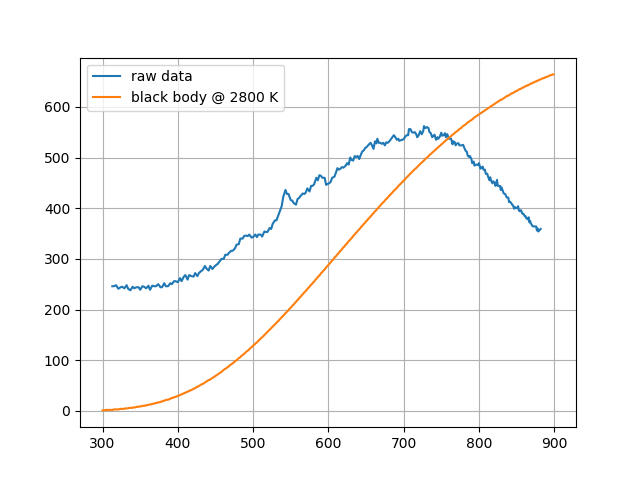
I added the calculated 2800 K black body spectrum to the graph (intensity scale is arbitrary).
The maximum of the raw spectrum is at wavelength of 727 nm which, according to Wien’s displacement law, corresponds to 3986 K temperature. By the same law the peak of 2800 K black body emission should be at 1035 nm. So the maximum has shifted… a lot and now we really need the intensity calibration.
Continue in Part 2.
[1] Using a halogen lamp to calibrate an optical system for UV-VIS radiation detection
CRISTINA YUBERO, M. CARMEN GARCÍA, M. DOLORES CALZADA
Optica Applicata, Vol. XXXVIII, No. 2, 2008 (link).

 Experimental Photonics