
It’s time to add some optics to the mini-spectrometer project. This post covers basics for choosing a front lens.
Purpose of the front lens is to collect light into the spectrometer entrance slit. Since the sensor of the mini-spectrometer has already proven to be very sensitive and I want to keep the whole system mini-size the front lens will be a compact singlet.
Intended application sets guide lines for lens selection. My wish is to be able to measure atmosphere using reflection from the Moon. Hmm…did I just state my grand vision for this project?
So I need a lens that:
- has a suitable form for projecting faraway objects to its focal plane,
- has a flat transmission curve for whole spectral range,
- whose image of the full Moon fills the entrance slit properly and
- matches with the numerical (NA) aperture of the spectrometer.
1. This would mean either so called “best form” or plano-convex. I choose the latter. Plano surface is handy when designing mechanics and with this application there shouldn’t be much need to worry about aberrations (coma and spherical) of the extended image.
2. No anti reflection coatings.
3. To estimate suitable focal length so that the full Moon fills the 0.5 mm entrance slit:
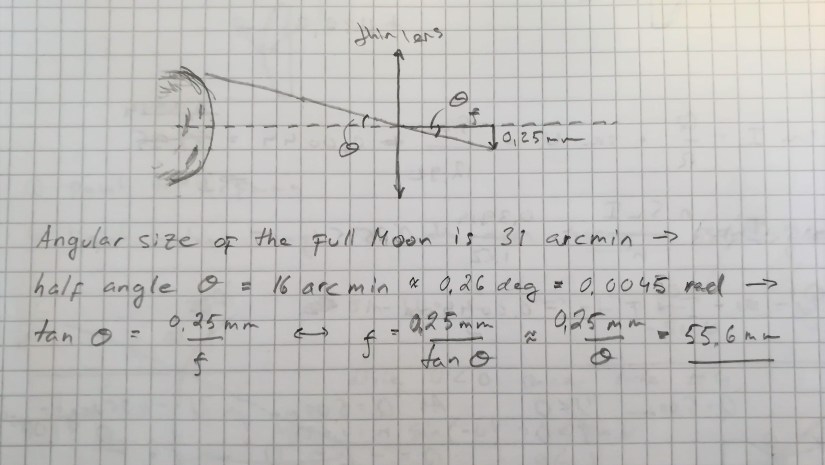
Focal length of 56 mm would meet the requirement.
4. The data sheet says “Optical NA (solid angle) is 0.22“. The numerical aperture (NA) is an imaginary cone limiting rays that can enter the spectrometer. Rays arriving outside of that cone have no effect to measured spectrum (ideally). Larger the numerical angle more light/power the sensor receives. In two dimensions the numerical aperture is commonly defined as
NA = n sin(θ) , where θ is the half angle of the cone and n is the refractive index of the medium (in air n=1.0).
The NA together with the focal length can be used to calculate the minimum lens diameter. Or maybe I should say lens aperture. Larger lens is usually needed since all the lens surface can’t be utilized. Some part of the lens edge will be blocked by mechanics.
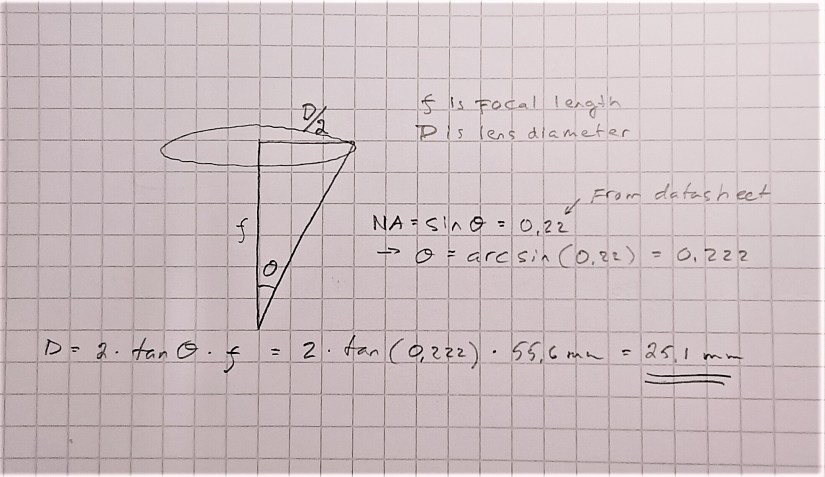
So now we know what is needed, a plano-convex with f = 56mm and D > 25mm without any coating.
UPDATE on 28.8.2019
I have to make some compromises with the lens selection. Although we just calculated that optimal focal length for the stated purpose is around 56 mm I’m not willing to use such a lens. Not yet anyway. My plan is to use a 3D-printer to make the mechanics prototype. With that technology increasing dimensions mean increasing manufacturing time and costs. That is not critical if you own a 3D-printer, but most of us have to use printing service.
So I chose a lens with 25 mm focal length. Reduced focal length leads to smaller lens diameter and the minimum is now 11 mm. These values led me to choose Edmund Optics model #37-789. The picture of the full Moon will now be 0.2 mm high on the entrance slit.
I hope that this compromise didn’t ruin the usability. Pointing the spectrometer to correct direction became just much harder. Once I have field proven mechanical design I probably go back to longer focal length lens.

 Experimental Photonics